By Nicola Slawson, The Guardian, adapted by Newsela staff
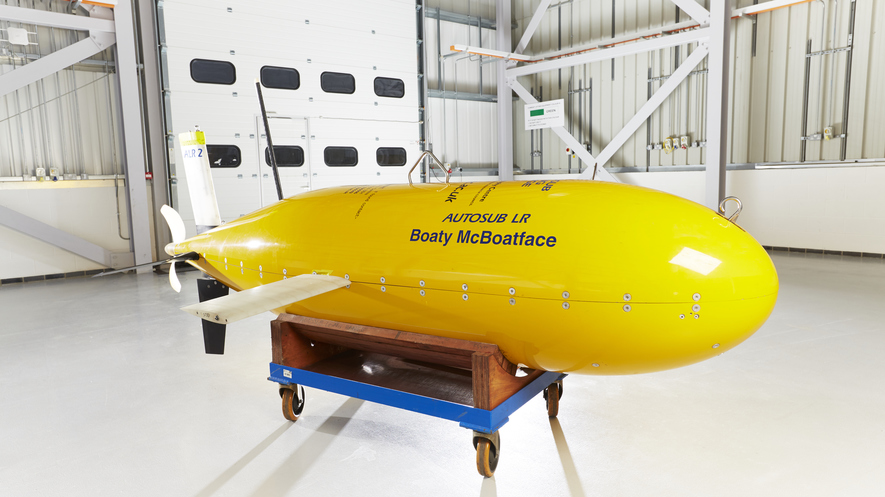
A small yellow robot submarine is being sent on its first Antarctic mission. The submarine is called Boaty McBoatface, after a competition to name a new polar research ship backfired.
Boaty has arguably one of the most famous names in recent maritime history. It is a new type of autonomous underwater vehicle (AUV), which will be able to travel under ice and reach depths of 6,000 meters. Boaty will transmit the data it collects to researchers via a radio link.
Its mission will be to investigate water flow and turbulence in the dark depths of the Orkney Passage. This is an over 2-mile deep region of the Southern Ocean, also known as the Antarctic Ocean. The data Boaty collects will help scientists understand how the ocean is responding to global warming.
The name “Boaty McBoatface” was given after a campaign by the Natural Environment Research Council (NERC). The campaign asked members of the public to suggest names for a new polar research ship.
Former BBC Radio Jersey presenter James Hand jokingly suggested Boaty McBoatface. It quickly became the most popular choice. The name won the vote by a huge majority.
The NERC, however, said it would have the final say. The most popular name would not necessarily be the one chosen, the NERC decided. It instead named the $250 million ship after the naturalist and broadcaster Sir David Attenborough.
However, in a nod to the democratic process, it allowed silliness to prevail by preserving the name for the remotely operated sub-sea vehicle.
Boaty will travel on the British Antarctic Survey (BAS) research ship James Clark Ross. The ship departed from Punta Arenas in Chile on March 17.
The lead scientist for the expedition is Professor Alberto Naveira Garabato from the University of Southampton. Garabato said the team will use Boaty to study how winds and warming waters affect deep-sea currents. In the Orkney Passage, the submarine will “measure how fast the streams flow, how turbulent they are and how they respond to changes in winds over the Southern Ocean.”
The team’s goal, Garabato added, is to learn enough about these processes to be able to factor them into climate models. Scientists use these models to figure out how the climate will change over time, and what the effects will be.
Boaty will be sent back and forth through a cold, deep ocean current. The current forms an important part of the global circulation of ocean water.
In 2019 Boaty McBoatface will be fitted with acoustic and chemical sensors. It will be sent into the North Sea to “sniff out” signals associated with the artificial release of gas beneath the seabed. A future aim for Boaty will be to attempt the first-ever crossing of the Arctic Ocean under ice. The venture has the potential to deliver a significant change in scientists’ ability to observe change in this vital region.
The National Oceanography Center, which developed the fleet of marine robots, also created a cartoon likeness of Boaty. The group will use it help tell the story of ocean exploration to children. A full-sized inflatable Boaty will also travel to events across the country.
 Saldino Science
I think that this article vividly described Boaty McBoatface and how it will help us explore the ocean when it will be sent back and forth through a cold ocean current, which is an important part of the global circulation of ocean water. I think that this will help us in the field of science and we will discover more about the parts of the global circulation of ocean water. I think that it is good that Boaty will eventually be able to cross the Arctic Ocean under ice which will help us identify new species and new environments. I think that it is important to us because it will help us find new species and how they live along with some of the questions we have about aquatic life.
LikeLike
I think that this article does a good job of describing BoatyMcBoatface and was fun to read. The author talks about how NERC let the public vote on what the name of the new AUV. As for BoatyMcBoatface, I think it is borderline revolutionary that we can have an AUV that can go in these cold temperatures in the far south. This can be very useful for us because it can tell us information about the vast southern ocean that humans can’t reach.
LikeLike
the Article was really interesting because the article says that the submarine could travel under ice and reach depths of 6,000 meters. The name “Boaty McBoatface” was given after a campaign by the Natural Environment Research Council (NERC). And the boat helps reserchers study the ocean. This was interesting because this submarine help reserchers find out more about the ocean.-NF
LikeLike
I really liked this article. This article was really nice because it talks about a new boat and how we got to actually name it. I think this is important because this boat will help us to now understand more about the ocean and how we can help it. I also relate to Kunaal I think this article was very fun to read and now we can learn more about our world.
LikeLike
I think that this article was very informative and interesting. I think that the BoatyMcBoatface is going to be good for the environment because once it is in the ocean it will be able to see anything. That means that if there is a problem in the ocean it can be fixed and save the environment. The article also gave a really good description of the BoatyMcBoatface. Over all this was a great article and I learned a lot from it.
LikeLike
I think this article was very interesting because it showed how the AUV was named and what it’s goals were. It surprised me due to the fact that the fan favorite name came to become it’s name because of a joking radio presenter. I think the outcome of this machine’s exploration would be really cool because it will help us possibly find a way to stop global warming. I think this will lead to answers and will prove really important for the earth.
LikeLike
Hi akul. I think this is interesting because boaty will help with boats sail through spotty spots easierly.
LikeLike