Extreme pressure? Diamonds can take it

By Emily Conover

February 19, 2021 at 6:30 am

Diamond is surprisingly good under pressure. Its crystal structure holds up even when compressed to 2 trillion pascals. That’s more than five times the pressure in Earth’s core. Scientists reported this gem of a result January 27 in Nature.

The finding is surprising because diamond isn’t always carbon’s most stable structure. Pure carbon can take on many forms. Diamond is one. Others include graphite (found in pencil lead) and tiny, cylinder shapes called carbon nanotubes. Carbon’s atoms are arranged in different ways for each form. Those patterns can be more or less stable under different conditions. Usually, carbon atoms take on the most stable state possible. At normal pressures on Earth’s surface, carbon’s most stable state is graphite. But given a forceful squeeze, diamond wins out. That’s why diamonds form after carbon takes a plunge inside Earth.

Continue reading “Extreme pressure? Diamonds can take it”

Healthy soils are life-giving black gold

By Catherine Arnold

February 25, 2021 at 6:30 am

Look out the window or walk over to a patch of soil near your home. Depending on where you live, it could be reddish brown, black, dark gray or even the color of rich, dark chocolate. If it’s moist enough, run your hands through it. It may separate into thick clumps that can hold water and later release it. With a few exceptions — such as desert sites — this is how good soil behaves. Less obvious to the casual glance, that piece of earth is likely throbbing with life.

In fact, the number of microscopic organisms that live in a shovelful of rich garden soil exceeds the number of plants and animals inhabiting the entire above-ground Amazon rainforest. And the Amazon is known for having more plants and animals than any other land-based habitat.

Continue reading “Healthy soils are life-giving black gold”

Italy’s Mount Etna Puts Up A Dazzling Show

By Daksha Morjaria

Mount Etna, Europe’s most active volcano, has been erupting regularly since 2011. However, the latest series of explosions, which began on February 16, 2021, has been particularly noteworthy. Emanating from the youngest of the volcano’s four craters — the Southeast Crater— they have spewed spectacular fountains of lava as high as 0.9 miles (1.5 kilometers). To put it in perspective, that is about three times the height of One World Trade Center, the tallest building in the United States.

“The most recent novelty is that the last six eruptive paroxysms were among the most violent in the Southeast Crater’s young history,” says Marco Neri, a volcanologist with Italy’s National Institute of Geophysics and Volcanology (INGV).

The eruptions have been coming from the volcano’s Southeast Crater (Credit: Go-Etna.com)
Continue reading “Italy’s Mount Etna Puts Up A Dazzling Show”

Volcanoes on Dwarf Planet Ceres Ooze Ice Instead Of Lava

By Maitreyi Mantha from Dogonews

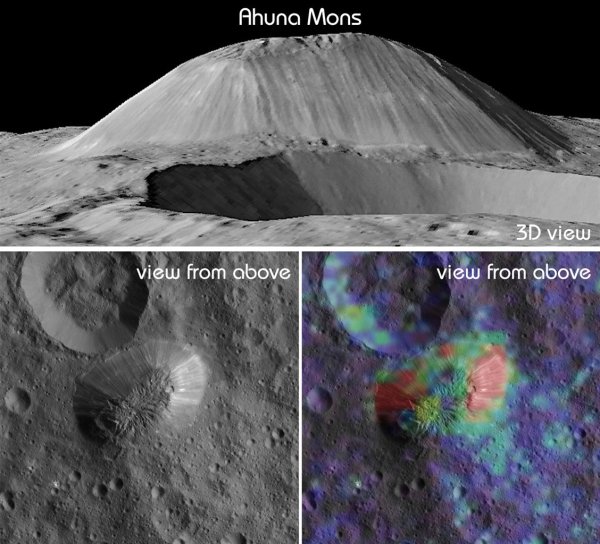
While the volcanoes on Earth eject fiery lava, ash, and smoke, those on Ceres, a dwarf planet that orbits between Mars and Jupiter, have been spewing ice throughout its history. The chain of events leading to the discovery began in 2015 when NASA’s spacecraft Dawn, sent to explore the asteroid belt where Ceres resides, captured some high-resolution images of its icy, rocky terrain. On the dwarf planet’s crater-covered surface, was a solitary 4-km ( 13,000 feet) tall mountain. Continue reading “Volcanoes on Dwarf Planet Ceres Ooze Ice Instead Of Lava”

Blog at WordPress.com.

Up ↑

Design a site like this with WordPress.com
Get started